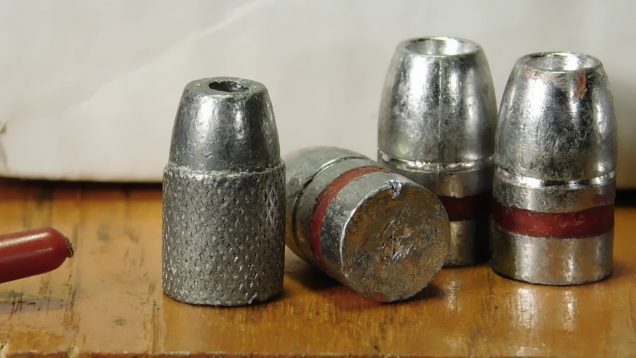
Bullet casters may not want a large quantity of a certain hollow point design. If so, they can certainly avail themselves to hollow point cast bullets from some of our fine commercial casters like Matt's Bullets.
Getting all my stock updated with their Brinell Hardness re-tested and think I may have discovered a ‘free’ source of Tin we may have been overlooking. Part of these test will be using lead that most of us casters have on hand, using lead that is cheap and readily available to us. CharlieBrassStufferBorn in 1950…HS […]
Brine is used in a number of heat treatments, particularly for steel, so I'm interested to see how it works with my wheel-weight alloy. For this experiment I'll be using an 8:1 mixture of water and Sodium Chloride (Table Salt) at room temperature.
As a followup to my recent tests with quenching cast bullets in antifreeze and brine, I decided to do a pair of secondary tests using chilled versions of the same fluids. One of the advantages to both these liquids is that they can be cooled below the freezing point of water, potentially increasing the temperature differential between the coolant and the bullet.
This is a long winded follow-up to my recent video asking: why do most of my 45ACP bullets shot from my 1911 have "funny" marks on the side? Also, how soft can our cast bullets be in our semi autos before the chambering process causes too much damage to the bullet nose as it contacts the feed ramp? Inquiring minds want to know!
Nope, NOT behind enemy lines. Just 300 pounds of future blaster pills.p I inventoried my lead stash. I actually have closer to 400#, but two pails are deeply stashed under the steps where I need a come-along to drag them out, so just estimating they weigh 100#. They were wheel weights I salvaged so they […]
Why do most of my 45ACP bullets shot from my 1911 have "funny" marks on the side? Also, how soft can our cast bullets be in our semi autos before the chambering process causes too much damage to the bullet nose as it contacts the feed ramp? Inquiring minds want to know!