



Frankford Arsenal Platinum Series Brass Dryer

TATV Canada
Frankford Arsenal Platinum Series Brass Dryer
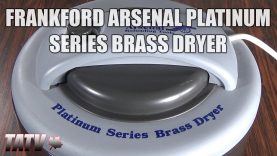
In this article we’ll be taking a look at the Frankford Arsenal Platinum Series Brass Dryer. This tool is designed specifically to simplify and speed up the process of drying out brass after it’s wet-tumbled.
When I first bought this thing I was really excited, as normally I dry my brass using a towel to make sure it doesn’t tarnish or spot, then leave it out overnight to air dry the rest of the way. Anything that reduces the amount of time and energy I spend on that little ‘delight’ sounds good to me, so I decided to give it a try.
Contents
In terms of what you get for your money, the unit basically consists of a heater/fan combination that stacks on top of a series of trays. Once activated, it heats and circulates air through the entire structure, drying out your brass without the need for any special media or other components.
Build Quality
The first thing you should know is it’s virtually entirely made from plastic, a lot of which feels very cheap. The trays in particular are flimsy and somewhat brittle. I wish I could tell you they’re at least well built and fit together nicely, but that’s just not true. They’ve got a very narrow rim around the edges which makes them challenging to line up properly when assembled, as does the lid. There aren’t any clips or anything else that could be used to secure the dryer together, resulting in a lot of gaps that fail to seal the air in properly. Most disappointing of all is the fact that the plastic body, particularly that of the trays, seems to be very susceptible to heat warpage, which is bizarre considering this thing is actually designed to reach temperatures of up to 160F.
Design
Similarly, the design leaves a lot to be desired. While the dryer does come with a very generous five trays which combined, can hold something like 2,000 .223 casings, it’s pretty much downhill after that.
We all know heat rises, yet for some reason the engineering team at Frankford Arsenal decided to place the heating element and fan on the top, rather than the bottom. I won’t say the air fails to reach the bottom as that’s not true, but I can’t help but think it would work a lot better if the hot air was pushed upwards rather than downwards. There’s no on/off switch, no timer, and the power cable is extremely short; this resulted in my having to use an extension cable and outdoor electric timer.
Honestly, the most frustrating thing about the design isn’t number of features that excluded, so much as the fact that they’re standard on Frankford Arsenal’s rotary tumbler, which theoretically is what you’d be using with this tool. It boggles the mind that key features like a timer, rubber seals, and a long power cable were deemed essential on one product, while inexplicably omitted from another made the by same company.
Operation
I could go on and on about the design and build quality, but lets set those aside for a moment and look at the operation. As with any tool, the real test is in the results, so lets see how it looks in action.
I began by wet-tumbling a couple hundred .45ACP casings. If you’d like to see what they looked like before, by all means check out the video above for some reference shots. Once processed, they looked factory-new, albeit very wet.
Next I proceeded to spread about half each on the top two trays of the brass dryer. These were specifically selected since they’re the closest to the heater and fan, and theoretically should dry the best.
With this done, I went ahead and lined the trays up as much as I could, to ensure the best seal possible; same with the lid. As you’ll see in the video above, this is a surprisingly difficult task owing to the poor design and construction of the unit.
Finally I set the temperature to the most powerful setting, and the timer to run for two hours; that’s twice as long as Frankford Arsenal claims is necessary.
Results
After two hours I decided to see how the brass dryer performed. At first glance the brass didn’t look too bad; everything was shiny and clean. Upon closer inspection though, things rapidly became disappointing. If you watch the video above, you’ll note water spots everywhere. Any place where casings were touching each other, or even just in contact with the tray, you’ll find huge spots and tarnishing. The cause is pretty obvious; since the dryer doesn’t feature any kind of mechanical agitation, the brass effectively just sits in place causing the water to pool, which naturally leads to the tarnishing we’re seeing here.
As you can imagine, the second tray was even worse. A lot of water dripped down from the top, particularly since the airflow is traveling in that direction. Naturally most of it ended up on the next tray down. You can probably imagine what the fifth tray would have looked like like had it been in use.
Improvements
Shortcomings aside, if Frankford Arsenal were to re-release it with a few changes I think it could work a lot better.
A top featuring clips to secure the whole thing together would go a long way to increasing air pressure and rigidity. Sturdier trays lined with fabric on the inside, and a vinyl or rubber gasket around the edges to seal them would not only reduce water pooling, but further address the air leakage issues. Some kind of rotation or mechanical agitation would likely completely eliminate the spotting and tarnishing problems as well. Moving the heater and fan, or even just using a channel to direct the airflow up from the bottom would really put a dent in the dripping problem, while a builtin timer and longer cable are no-brainer’s that would just make the whole thing more convenient and user friendly.
Summary
So what do I think of the Frankford Arsenal Platinum Series Brass Dryer? Well, I think you’ve probably got a pretty good idea by this point. It’s certainly faster than air drying alone, but I still have to give each casing a once over with a towel or rag, and to me, that defeats the whole purpose of using it.
Now some of you are probably saying ‘Hey, who cares about some water spots and tarnishing, it still loads, and it still shoots’, and you’re absolutely right, it will. The thing is, if you’re going to the trouble and expense of wet tumbling, you’re probably the kind of reloader who wants their ammo to the look the best that it can (I know I do), and the reality is this tool just isn’t going to give you that factory-finish.
That said, do I still use it? Yes. Would I buy another one? No. At this point, the only real function it serves for me is to provide a convenient place to lay out my brass to finish drying after after I towel it off, and speed up the evaporation of any water left inside the cases. Knowing what I know now, I would never have wasted my money on this tool and frankly, neither should you.
Tactical Advantage TV is focused on delivering short, to-the-point content on a host of subjects related to firearms, casting, reloading, optics and accessories. In addition to theoretical discussion, I will be performing a number of practical demonstrations on processes and products, including my own designs.